
Advanced Certificate Course on Cybercrime & Digital Justice by Naksh Foundation, MUJ & PDEU [Aug 17-23; Online]
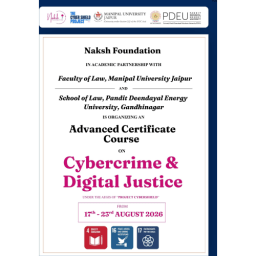 Naksh Foundation; Faculty of Law, Manipal University Jaipur; School of Law, Pandit Deendayal Energy University, Gandhinagar.
About the course
Naksh Foundation, in academic partnership with the Faculty of Law, Manipal University Jaipur and the School of Law, Pandit Deendayal Energy University, Gandhinagar, is organising a seven-day Advanced Certificate Course on Cybercrime & Digital Justice under the aegis of Project CyberShield. The course runs from 17 August 2026 to 23 August 2026.
The digital transformation of society has altered the nature of crime, governance, evidence and justice. Cybercrime today spans unauthorised access, financial fraud, identity theft, platform-enabled harms and artificial-intelligence-assisted offences, while legal systems face fresh questions on attribution of liability, admissibility of digital evidence, data protection, algorithmic governance and access to justice in digital environments. The course offers an interdisciplinary examination of cybercrime and digital justice through contemporary Indian legal and regulatory frameworks, drawing on the Information Technology Act, 2000, the Bharatiya Nyaya Sanhita, 2023, the Bharatiya Sakshya Adhiniyam, 2023, the Digital Personal Data Protection Act, 2023 and emerging AI governance initiatives.
About the organisers
Naksh Foundation is a Section 8 non-profit organisation working on legal aid, legal literacy and cybercrime awareness across India. Through its flagship initiative Project CyberShield it runs workshops, awareness campaigns and community outreach on legal rights, digital safety and access to justice. The Foundation states it has conducted over 1,000 training sessions, mobilised 1,500+ volunteers and reached more than 100,000 people.
Faculty of Law, Manipal University Jaipur offers B.A. LL.B. (Hons.), B.B.A. LL.B. (Hons.), LL.B., LL.M. and Ph.D. programmes, combining classroom teaching with moot courts, legal aid, internships and research. Manipal University Jaipur was ranked 32nd in the NIRF 2025 Law Rankings.
School of Law, Pandit Deendayal Energy University, Gandhinagar is a Bar Council of India approved institution following an interdisciplinary and experiential approach, with moot courts, legal aid clinics, internships, research projects and faculty exchanges built into the curriculum.
Course structure: seven modules
- Module I - Cybercrime: conceptual foundations and emerging threat landscape
- Module II - Legal and regulatory framework governing cybercrime in India
- Module III - Cyber investigation, digital forensics and electronic evidence
- Module IV - Artificial intelligence, emerging technologies and cybercrime
- Module V - Data protection, privacy and platform accountability
- Module VI - Cyber victimisation and digital justice
- Module VII - Governance of cyberspace and future regulatory challenges
Objectives and learning outcomes
The course seeks to examine the changing nature and dimensions of cybercrime; analyse India's legal and institutional framework governing cyber offences; explain the evidentiary and investigative challenges associated with cybercrime; explore the impact of AI in the commission, prevention and regulation of cyber offences; assess issues of privacy, data protection and platform accountability; examine victim-centric approaches and access to justice in digital environments; and evaluate emerging regulatory and governance responses to technological risk.
On successful completion participants should be able to understand the evolving nature of cybercrime and its societal implications, analyse the Indian regulatory framework for cyber offences, evaluate evidentiary and investigative challenges in cybercrime prosecution, assess the implications of artificial intelligence in cybercrime and governance, examine privacy and platform accountability questions, appreciate the role of digital justice and victim-centric approaches, and engage with contemporary debates on cyber governance and technology regulation.
Who can participate
Students, research scholars, faculty members, academicians, lawyers and working professionals are eligible to register. The registration form provides separate tracks for Manipal University Jaipur and PDEU students and scholars, students and research scholars from other institutions, faculty, corporate professionals, advocates and other working professionals, and Naksh Foundation volunteers. Students are asked to upload a student ID card (PDF, JPG or PNG, up to 1 MB) at the time of registration.
Session format
- One live session per day on Zoom, across the seven days from 17 to 23 August 2026
- Each session runs for 1.5 hours
- Session recordings are shared with all registered participants after each session
- Timely submission of the feedback form after each session is mandatory
- 75 per cent attendance is mandatory
Assessment and certification
An assessment is conducted on 24 August 2026, after the course concludes. It comprises 30 multiple-choice questions to be completed in 15 minutes, and participants must score at least 15 out of 30 (50 per cent) to qualify. Appearing for the assessment is mandatory for all participants and the grade obtained is reflected on the certificate.
Grades are awarded as A for 100-91 per cent, B for 90-81 per cent, C for 80-61 per cent and D for 60 per cent and below. Percentage scores are rounded to the nearest whole number, with decimals below 0.50 rounded down and 0.50 or above rounded up. Participants who attend the sessions with a minimum of 75 per cent attendance and score at least 50 per cent in the final assessment receive a Certificate of Completion. Certificates are distributed on 31 August 2026.
Registration and fee
Registration is open from 10 July 2026 to 14 August 2026 through the official form at naksh.org.
- Students and research scholars: ₹500
- Faculty, advocates, corporate and other working professionals: ₹750
- Naksh Foundation volunteers: ₹500
Volunteers who have been actively associated with Naksh Foundation for more than four months are eligible for an additional ₹250 fee support from the Foundation, bringing their fee down to ₹250. The Foundation states it will bear up to 67 per cent of the registration fee for such volunteers, who must obtain a coupon code from their zonal head. Registration is treated as complete only once the form is duly filled and the applicable fee is paid.