
Call for Papers: CPAJ Newsletter, NLU Odisha [Volume IV]
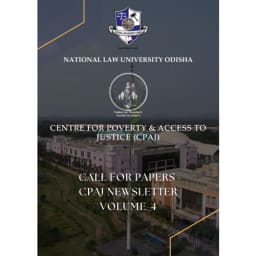 Centre for Poverty and Access to Justice (CPAJ), National Law University Odisha, Cuttack.
About NLU Odisha and the Centre for Poverty and Access to Justice
National Law University Odisha (NLUO), Cuttack was established under Act 4 of 2008 by the Odisha State Legislature and has grown into one of the country's established institutions of legal education, with a stated focus on socially relevant education, research through specialised centres and student-led societies.
The Centre for Poverty and Access to Justice (CPAJ) works on improving access to justice for individuals and communities facing social, economic or institutional disadvantage. The Centre undertakes research, legal awareness programmes, policy advocacy, capacity-building initiatives and collaborations with governmental and non-governmental organisations to identify and address barriers that prevent people from accessing legal remedies.
About the Newsletter
CPAJ invites original and unpublished submissions for Volume IV of its Newsletter. The Newsletter is meant as a platform for students, researchers, academicians, legal practitioners and policy professionals to engage with contemporary questions of poverty, inequality, access to justice and socio-economic rights through concise legal scholarship.
Themes
The Centre seeks submissions on the following themes, though the list is indicative and authors are encouraged to advance related or novel lines of inquiry:
- Poverty and Constitutional Rights
- Access to Justice in India: Challenges and Reforms
- Legal Aid and the Role of Institutions
- Marginalised Communities and Social Justice
- Gender, Poverty, and Law
- Labour Rights, Informal Employment, and Social Security
- Digital Inclusion, Technology, and Access to Justice
- Environmental Justice and Climate-Induced Poverty
- Housing Rights, Homelessness, and Urban Poverty
- Healthcare, Public Welfare, and the Right to Health
- Education and Equal Opportunity
- Child Rights and Juvenile Justice
- Disability Rights and Inclusive Justice
- Tribal Rights and Forest Governance
- Migration, Displacement, and Human Rights
- Contemporary Judicial Developments Relating to Poverty and Access to Justice
Categories of Submission and Word Limits
- Articles (900 to 1,000 words): a well-researched and analytical discussion of a legal, policy or socio-economic issue.
- Case Comments (750 to 900 words): critical analyses of recent judicial pronouncements concerning poverty, human rights, welfare legislation or access to justice.
- Legislative or Policy Reviews (800 to 900 words): reviews of recent statutes, bills, government policies or reports impacting vulnerable communities.
- Opinion or Commentary (700 to 800 words): short analytical pieces on contemporary issues, reforms or emerging developments.
All word limits are exclusive of footnotes.
Formatting and Citation Guidelines
- Main body: Times New Roman, 12 pt, 1.5 line spacing.
- Headings: Times New Roman, 14 pt, bold. Subheadings: Times New Roman, 13 pt, bold or italic.
- Footnotes: 10 pt, single line spacing, used only to cite images or empirical data.
- Margins of 1 inch on all sides, A4 paper, justified alignment, 0 pt paragraph spacing before and after. Page numbers are not required.
- Citations must strictly follow OSCOLA (4th Edition).
Submission Guidelines and Plagiarism Policy
- No abstract is required.
- The manuscript must be original and unpublished. Simultaneous submissions are discouraged, and authors must promptly inform the Editorial Board if a manuscript is accepted elsewhere before the review concludes.
- Co-authorship of up to two authors is permitted.
- The manuscript must carry no identifying information, to allow a fair review. Author details (name, institutional affiliation, designation, email address and contact number) go on a separate cover page.
- Manuscripts must be submitted in Microsoft Word (.doc or .docx) format.
- Authors are responsible for the accuracy of facts, citations and references.
- A similarity index above 10 per cent, excluding properly cited quotations and references, may lead to desk rejection. Any plagiarism or academic misconduct results in immediate rejection.
- The Editorial Board may make minor editorial changes to grammar, formatting and style, and may reject submissions that do not conform to the guidelines or fall outside the scope of the Newsletter.
Fee
The call states no submission, processing or publication charge. Participation is free.
How to Submit
Manuscripts must be submitted through the official Google submission form linked in the call for papers. The form opens in a signed-in Google session. The last date for submission is 30 September 2026.
For any queries, authors may write to the Editorial Board of the Centre for Poverty and Access to Justice at cpaj@nluo.ac.in.