
Call for Papers: International Review of the Red Cross (Scopus, Q1), Thematic Edition on Protection of Civilians and IHL in the Age of Artificial Intelligence
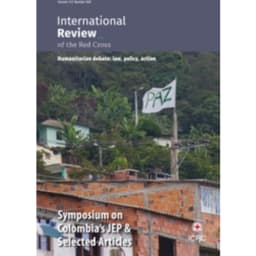 International Review of the Red Cross (ICRC), published by Cambridge University Press.
About the Journal
The International Review of the Red Cross (IRRC) is a peer-reviewed journal published by the International Committee of the Red Cross (ICRC) and Cambridge University Press. It promotes reflection on humanitarian law, policy and action in armed conflict and other situations of collective armed violence.
It is a specialised journal in humanitarian law that endeavours to promote knowledge, critical analysis and development of the law, and to contribute to the prevention of violations of rules protecting fundamental rights and values.
Indexing and metrics (verified at Scimago): ISSN 1607-5889 (print) and 1816-3831 (online); Scopus coverage 2005 to 2026; SJR 2025: 0.702, Quartile Q1 in Law; H-Index 54; subject areas Law and Sociology and Political Science.
About the Call
The Review invites proposals for a thematic edition examining the implications of the use of artificial intelligence (AI) in relation to armed conflict for the protection of civilians and for international humanitarian law (IHL).
For the purpose of this call, the Review understands "AI" broadly, to include machine-learning systems, predictive analytics, computer vision, natural-language processing, large language models, decision-support systems, and other computational systems used to generate, classify, predict, recommend, or assist decisions related to armed conflict.
Theme 1: Use of AI in Armed Conflict by Humanitarian Organisations
- What are the opportunities, limits and risks of using AI for anticipatory and humanitarian action, such as needs assessment, resource allocation, early warning, negotiation strategies, protection analysis and activities?
- When principled humanitarian organisations consider using AI, how can they ensure their activities remain aligned with the principles of humanity, impartiality, neutrality and independence, as well as with the "do no harm" approach?
- How can technology and humanitarian communities learn from each other, for example regarding the principles guiding their respective domains of activity?
Theme 2: Use of AI by Armed Actors to Support Compliance with IHL
- Can AI be designed, trained and deployed in ways that support compliance by armed actors with the core IHL obligations of distinction, proportionality and precautions in attack?
- What legal and operational safeguards are required to address risks related to data quality, bias, system unpredictability and accountability when AI is used in the conduct of hostilities?
- Can protection risks arising from the collection, labelling and operational use of civilian data in AI-enabled military systems be mitigated?
- Can protection risks arising from the use of generative AI, synthetic media and algorithmically amplified information operations during armed conflict be mitigated?
- Outside the realm of the conduct of hostilities, can AI be used in ways that support compliance with IHL?
Theme 3: Use of AI for IHL Research and Analysis
- Can the use of AI for IHL research and analysis ensure methodological rigour and transparency, mitigate bias and accurately reflect the diversity of legal interpretations and sources in IHL?
- How can outputs generated by AI, such as large language models, support compliance with IHL?
- What are the opportunities, limits and risks in using IHL interpretation or compliance assessments generated by AI for real-life decision-making?
Theme 4: Governance of AI Used in Armed Conflict
- Beyond IHL, which legal, policy and ethical frameworks and principles apply to the use of AI in armed conflict, and what is their interplay with IHL?
- What roles and responsibilities do private technology companies and transnational digital infrastructures play in the development and governance of AI used in armed conflict?
- Looking ahead, which forms of governance could be developed to ensure that AI strengthens the protection of persons affected by armed conflict?
What Your Abstract Must Contain
The proposal should consist of an abstract of a maximum of 700 words and a short biography. In the 700-word abstract, the Review asks you to include:
- The proposed title
- The main arguments you intend to develop
- An explanation of how your topic can strengthen the protection of persons affected by armed conflict
Selection, Eligibility and Languages
Selection will prioritise innovative proposals with clear potential to contribute to and advance legal and policy debates on this topic in the years ahead.
- For this call in particular, the Review strongly encourages multidisciplinary teams of authors.
- The Review also encourages empirical research on AI systems developed in different regions of the world.
- In line with its commitment to diverse voices, submissions are encouraged from established and emerging voices alike.
- Proposals can be co-authored.
- Proposals may also be submitted in Arabic, Chinese, French, Spanish and Russian, in addition to English.
Rules on Generative AI, Review and How to Submit
Applicants are strongly discouraged from using generative AI tools to draft their abstracts or articles. Undisclosed use of AI may lead to the immediate and permanent disqualification of your proposal.
Send your abstract and bio as a single Word document to review@icrc.org, and include "Protection and IHL in the Age of AI" in the email's subject line, by 1 September 2026.
All articles that meet initial screening criteria will undergo a double-blind peer review process. If invited to submit a full-length article, the target length is 8,000 to 10,000 words including footnotes, although the Review is open to longer pieces.
The Editorial Team is supported by a Jury including Cecile Aptel (Editorial Board, IRRC), Zena Assaad (Australian National University), Pierrick Devidal (ICRC Geneva), Jessica Dorsey (Utrecht University), Heidi Kandiel (ICRC Geneva), Andrea Raab-Gray (ICRC Global Cyber Hub, Luxembourg), Johan Rochel (EPFL, Lausanne) and Yuval Shany (The Hebrew University of Jerusalem).