
Call for Papers: Policies in Tech Law and Governance in the Global South at VIT Chennai [Hybrid, 5-6 February 2027; Abstracts by 30 November 2026]
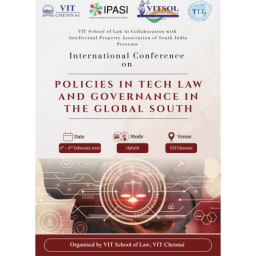 VIT School of Law, VIT Chennai, in collaboration with the Intellectual Property Association of South India.
About the conference and the organisers
VIT School of Law, VIT Chennai, in collaboration with the Intellectual Property Association of South India, presents an International Conference on Policies in Tech Law and Governance in the Global South. It will be held in Hybrid mode on 5 - 6 February 2027 at VIT Chennai.
VIT School of Law was established in 2014 and is approved by the Bar Council of India. It has over 1,200 students across its B.A. LL.B. (Hons.), B.B.A. LL.B. (Hons.), LL.M. and Ph.D. programmes and 55 core faculty members. Vellore Institute of Technology was founded in 1984 as Vellore Engineering College and was conferred university status in 2001.
Aim of the conference
Countries in the Global South face challenges ranging from technology accessibility and resource allocation to data privacy, infrastructure and institutional shortcomings. The conference aims to bring together policymakers, researchers, legal professionals, academicians and students to advance evidence-based, context-appropriate and equitable technology governance. It will explore practical implementation strategies, examine global data justice and address international trade relationships.
Themes and sub-themes
The conference invites well-researched original papers across six tracks and their sub-themes.
1. Artificial Intelligence Governance
- AI, Socio-Economic Rights and Inequality
- Inclusive AI, Accessibility, and Disability Rights
- Gender, AI, and Tech-Facilitated Violence
- AI, Culture, Belief, and Harm
- Safeguarding Children in the Age of AI
- AI Accountability, Transparency, and Safety
2. Data Protection and Privacy
- Data Sovereignty and Countering Digital Rights
- Privacy Rights of Vulnerable and Marginalised Groups
- State Surveillance, Biometric Databases, and Civil Liberties
- Digital Public Infrastructure (DPI) & Data Governance
- Cross-Border Data Flows and Regional Privacy Frameworks
- Health, Data Privacy and Bio-Tech Governance
3. Alternative Dispute Resolution and Tech Law Governance
- Online Dispute Resolution (ODR) and Access to Justice
- AI in Judicial and Arbitration Workflows
- Cross-Border E-Commerce and Digital Dispute Resolution
- Smart Contracts and Decentralised Dispute Mechanisms
- Protection of Consumer Rights in Tech-Enabled Disputes
- Institutional Frameworks for ADR in Tech Law
More tracks
4. Technology and Sustainable Development
- Tech Law and Policy for the UN SDGs
- Environmental Impact of AI and Digital Infrastructure
- E-Waste Management and Circular Tech Economy
- Climate Tech Transfer and Resilient Agriculture
- Smart Cities, Urban Governance and Digital Rights
- Tech-Enabled Disaster Risk Reduction and Disaster Management
5. Intellectual Property and Access to Technology
- IP Monopolies v. Public Interest and Essential Access
- Open Source Models and Technology Transfer
- Copyright, Fair Use, and Data Mining for AI Training
- Protection of Traditional Knowledge and Cultural Expressions
- Patent Thickets, Anti-Competitive IP Practices, and Innovation
- IP Governance in Emerging Tech (Biotech, Quantum, & Space etc)
6. International Trade and Technology Law
- Digital Trade Agreements and Global South Interests
- Regulating Big Tech Monopolies and Competition Policy
- FinTech, Cross-Border Payments, and Financial Inclusion
- Technological Sovereignty and Supply Chain Security
- Digital Taxation and Revenue Distribution
- Trade Secret Regulation v. Open Technology & Public Interest
Who can participate
Papers are invited from policy makers, academicians, practitioners, research scholars, administrators and students. Participation is open for academicians, policy practitioners, industry experts, researchers, early career professionals and students from diverse backgrounds.
For UG, PG and Ph.D. students, there is no bar on the number of participants from the same College, University or Institution.
Abstract submission guidelines
- Submit an abstract of 500 words, clearly indicating the sub-theme of the proposed research with relevant keywords.
- Co-authorship is allowed to a maximum of two co-authors per submission.
- The abstract must carry a cover page with: title of the paper, name of the author(s), designation, e-mail or institutional e-mail address, and postal address and contact number.
- Abstracts undergo double-blind peer review and only shortlisted abstracts are invited to submit final papers.
- No abstract or full paper is accepted after the last dates of submission.
- Abstracts and relevant documents are uploaded through the abstract submission form linked from the brochure.
Full paper instructions
- Word limit: 4000 to 8000, excluding footnotes and abstract.
- Citation format: APA 7th Edition.
- Font: Times New Roman (12).
- Line spacing: 1.5.
Important dates
Abstract submission closes on 30 November, 2026, and selected abstracts are intimated on 15 December, 2026. The brochure also lists 27 December, 2026 and 30 December, 2026 against registration and full paper submission; the conference follows on 5 - 6 February 2027. Check the brochure for which date applies to which step.
Registration and fee
Paper presenters can register after the acceptance of their abstract by paying the required fees. Only registered participants are allowed to take part in the conference. Fees are exclusive of GST and any other applicable taxes.
National participants
- Single Author (Students and Scholars): INR 2000
- Co-Author (Students and Scholars): INR 2500
- Single Author (Academicians, policy practitioners, professionals): INR 2500
- Co-Author (Academicians, policy practitioners, professionals): INR 3000
International participants
- Single Author (Students and Scholars): USD 40
- Co-Author (Students and Scholars): USD 50
- Single Author (Academicians, policy practitioners, professionals): USD 50
- Co-Author (Academicians, policy practitioners, professionals): USD 60
Publication, certificates and contact
Selected papers will be published by a reputed publisher. Presenters will be awarded a certificate of presentation, and best paper presenters will be awarded a certificate of merit.
For queries or clarifications, email chennai.tlawg@vit.ac.in.