
First Winter School on Digital Market Regulation by School of Law, CHRIST (Deemed to be University), Bengaluru [Hybrid; 7-11 September 2026]
 School of Law, CHRIST (Deemed to be University), Bengaluru.
About the Winter School
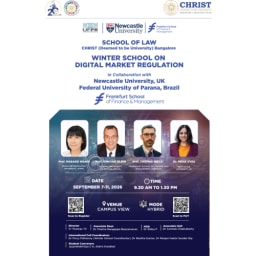
The School of Law, CHRIST (Deemed to be University), Bengaluru is holding its first Winter School on Digital Market Regulation from 7 to 11 September 2026, in collaboration with Newcastle University in the UK and the Federal University of Parana (UFPR) in Brazil. The Frankfurt School of Finance and Management, Germany is also listed among the Winter School collaborators in the brochure. The programme runs daily from 9.30 AM to 1.30 PM in hybrid mode, with the offline venue at Campus View on the Bengaluru Central Campus and an online attendance option for those who prefer it. It carries 15 academic hours of instruction delivered as 10 sessions over five days, at three hours of instruction a day.
Why the Course Is Being Run
The concept note sets out the problem the Winter School is built around. Multi-sided platforms, large-scale data aggregation and network effects have delivered real consumer efficiencies, but the same forces have produced unprecedented market concentration, with a small group of technology companies acting as systemic gatekeepers over the digital bottlenecks through which modern commerce must pass. Antitrust frameworks designed for the industrial economies of the twentieth century have proven structurally inadequate: ex-post enforcement depends on long investigations and litigation, and by the time an abuse of dominance is established the market has often tipped permanently in favour of the incumbent, leaving behavioural and monetary remedies ineffective. Jurisdictions have diverged in response. The European Union, the United Kingdom and Japan are building distinct ex-ante regulatory models to prevent anti-competitive conduct before it takes hold, while the United States, Korea, Brazil and Indonesia are addressing the same conduct mainly by adapting and rigorously applying existing competition law.
Programme Objectives
- To master the foundational microeconomics governing multi-sided digital platforms and network dynamics.
- To critically analyse the systemic failure of traditional ex-post competition law in fast-moving technology sectors.
- To dissect and compare emerging global ex-ante regulatory frameworks, including the EU's DMA and DSA, the UK's DMCC and India's Draft Digital Competition Bill.
- To investigate modern regulatory frontiers such as algorithmic collusion, generative AI vertical integration, AdTech supply chains and app store duopolies.
- To evaluate the legal and structural feasibility of remedies, balancing the case for market intervention against the preservation of technological innovation.
Day-by-Day Session Plan
- Day 1, Monday 7 September: Inaugural session at Campus View, followed by Session 1 on Platform Economics (microeconomics of multi-sided markets, network effects, strategic user lock-in) and Session 2 on ex-post antitrust failures and the ex-ante challenge of designating gatekeepers and core platform services, comparing the EU's DMA, Germany's Section 19a, the UK's Strategic Market Status regime under the DMCC Act, India's Draft Digital Competition Bill, Japan's smartphone legislation, and the approaches taken by Brazil and Indonesia.
- Day 2, Tuesday 8 September: Session 3 on the anatomy of gatekeepers and core platform services, covering self-preferencing algorithms, tying and bundling of digital utilities, default settings, revenue share agreements and anti-steering clauses; Session 4 on tech mergers and killer acquisitions, theories of innovation harm, the inadequacy of asset and turnover based merger notifications, transaction-value thresholds and reversed burdens of proof, with Grab-Uber, Gojek-Tokopedia and TikTok-Tokopedia as illustrative Indonesian cases.
- Day 3, Wednesday 9 September: Session 5 on data-competition and privacy frictions, including data hoarding and feedback loops as barriers to entry, the structural friction between competition enforcement and data privacy architecture under the GDPR and the DPDP Act, and privacy degradation as a qualitative antitrust injury; Session 6 on the European framework (DMA and DSA), the German Facebook case and Section 19a, algorithmic accountability, dark patterns and systemic risk audits.
- Day 4, Thursday 10 September: Session 7 on conflicts of interest in the marketplace and AdTech, where a single firm acts as buyer, seller and exchange in the programmatic advertising supply chain; Session 8 on algorithmic collusion and generative AI, covering hub-and-spoke pricing models, tacit versus explicit collusion by autonomous agents, illustrative cases from Brazil's fuel retail market and airline investigations, personalised pricing, and emergent GenAI bottlenecks in compute concentration, data moats and cloud partnerships.
- Day 5, Friday 11 September: Session 9 on sectoral monopolies and app stores, covering 30 per cent commission models, mandated in-app billing, side-loading and anti-steering disputes across the EU, India, Brazil, Indonesia and Japan; Session 10 on remedies and enforcement, weighing behavioural against structural remedies such as interoperability mandates, data silos and divestitures, and cross-border compliance, closing with a Capstone Evaluation Pitch in which student teams present regulatory solutions to a simulated digital market crisis.
Course Instructors
- Prof. Masako Wakui, Osaka Metropolitan University, Japan. Professor of Law, Visiting Professor at Newcastle University, and Professor Emeritus of Kyoto University. She has served as a researcher at the Japan Fair Trade Commission's Competition Policy Research Centre and as an expert member of METI's Monitoring Meeting on Digital Platforms, and is co-head of the Asian Chapter of the Academic Society for Competition Law (ASCOLA).
- Prof. Vinicius Klein, Federal University of Parana (UFPR), Brazil. Professor teaching undergraduate, LLM and PhD students, Coordinator of the Centre for Law and Economics Studies at UFPR, and a Parana State Solicitor. He holds doctorates in Civil Law (UERJ) and Economic Development (UFPR), and is Institutional Relations Director of the Brazilian Association of Law and Economics and Academic Director of the Brazilian Institute of Competition and Innovation.
- Prof. Thomas Weck, Frankfurt School of Finance and Management, Germany. Associate Professor for Public Law, Regulatory Law and Comparative Law, also lecturing at the School of German Law at Warsaw University. He was a Lead Analyst at the Monopolies Commission in Bonn from 2012 to 2022 and is co-chair of the German chapter of ASCOLA.
- Dr Neha Vyas, Newcastle University, UK. Lecturer in Commercial Law and a Fellow of the Higher Education Academy, with a Doctorate in Law from Goethe University Frankfurt. She previously taught competition law, corporate governance and international tax law at CHRIST University, Bengaluru, and is the author of Competition Law: Concepts, Law and Practice (Eastern Book Company, 2021).
Who Should Attend
The pedagogy pairs theoretical rigour with practical policy application and a comparative view of digital market regulation across borders. The programme is aimed at law students, PhD scholars, law faculty, advocates, policymakers and other professionals interested in the regulation of digital markets. The registration form offers three participant categories, namely students from India at UG, PG or PhD level, working professionals from India, and international participants, so applicants from outside India are expressly provided for.
Registration Fee and Payment
- Students from Indian universities: Rs 1,500 per delegate.
- Working professionals from India: Rs 2,500 per delegate.
- International participants: Rs 2,500 per delegate.
- Payment can be made by debit card, credit card, net banking or UPI. Route one is through the CHRIST website: open Menu, then E-services, then Certificate/Registration - Online Payment Portal, and select Category as Others, Campus as Bangalore Central Campus and Events as Workshop.
- Route two is the direct payment link at the South Indian Bank ChristFee portal.
- After paying, email a copy of the receipt to internationalconnect.slcu@christuniversity.in with the subject line "Fee payment and Registration for winterschool". The receipt also has to be uploaded on the registration form, which accepts one file of up to 10 MB.
Certification, Deadline and Accommodation
Certificates will be issued by the School of Law, CHRIST (Deemed to be University) on successful completion of the 15 academic hours and the Capstone Pitch. The registration form states that participants must complete their registration by 3 September 2026. The organisers have stated that they are not responsible for accommodation, and participants who opt to attend offline are expected to make their own arrangements. The participation fee is charged per delegate to offset the cost of preparing and organising the Winter School.