
Global Policy Drafting Challenge by School of Law, CHRIST (Deemed to be University), Bangalore [Hybrid; September 7-8; Cash Prizes Worth Rs 8,000]
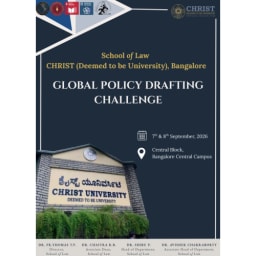 Intellectual Property Rights Committee (IPRC) and International Relations and Foreign Policy Committee (IRFPC), School of Law, CHRIST (Deemed to be University), Bangalore.
About the organisers
CHRIST (Deemed to be University) was born out of the educational vision of St Kuriakose Elias Chavara, an educationalist and social reformer of nineteenth century South India. Established as Christ College in 1969, it was declared a Deemed to be University in 2008. It was among the first institutions in India to be accredited by the National Assessment and Accreditation Council (NAAC) in 1998, and was re-accredited in 2004, 2016 and 2022. The University is ranked 67 among Indian universities in the NIRF India Ranking of the Ministry of Education, and offers Bachelor, Master and Doctoral programmes across humanities, social sciences, sciences, commerce, management, engineering, architecture, education and law to about 30,000 students.
The School of Law at CHRIST (Deemed to be University), Bengaluru, was established and administered by the Carmelites of Mary Immaculate (CMI). It offers undergraduate, postgraduate and doctoral programmes in accordance with the guidelines of the Bar Council of India and the University Grants Commission, and supplements a ten-semester curriculum with internships, clinical programmes, research supervision, seminars, guest lectures, workshops and value-added courses.
The International Relations and Foreign Policy Committee (IRFPC) works to build a comprehensive understanding of international law and international relations through reading circles, competitions and interactive discussions with alumni and experts. The Intellectual Property Rights Committee (IPRC) gives students a platform to engage with the evolving field of IP law under faculty coordinators, to network with IP practitioners and to publish research through its flagship newsletter, Intellectualis.
About the Global Policy Drafting Challenge
The Intellectual Property Rights Committee (IPRC), in collaboration with the International Relations and Foreign Policy Committee (IRFPC), is organising the Global Policy Drafting Challenge, a case-study-based policy drafting and presentation competition. The Challenge is designed to give participants a platform to engage with contemporary global issues at the intersection of intellectual property, international relations, technology and public policy.
The competition aims to develop policy drafting, research, analytical and problem-solving skills while encouraging interdisciplinary thinking and practical approaches to contemporary international challenges. Participants will engage with themes such as cross-border AI and copyright governance, AI-generated designs, geographical indications, indigenous rights and international trade. Through its case-study-based format, the Challenge seeks to encourage innovative thinking, practical policy-making and meaningful engagement with emerging global challenges.
Structure of the competition
Preliminary Round: conducted online. Participants are given the proposition or case study at the commencement of the round itself. An additional 15 minutes is allotted exclusively for reading and understanding the proposition before the drafting period, which lasts one hour, begins. The proposition is released only at the beginning of the round, and teams are expected to use the reading time to analyse the facts, identify the key issues and understand the policy problem before proceeding with their submission.
Quarter-Final Round: teams qualifying for the Quarter-Finals pay a registration fee of Rs 200 per team (not per participant) for participation in the offline rounds. The proposition for this round is released only once the top eight teams are decided.
Semi-Final and Final Rounds: participants will be duly intimated about the Semi-Final and Final Rounds at the Central Campus upon conclusion of the Quarter-Final Rounds.
Eligibility and team composition
- Open to students enrolled in any undergraduate programme, in any course and across any discipline, at recognised universities and institutions in India.
- Participation is in teams of a minimum of two and a maximum of three members.
- Cross-institutional teams are permitted.
- There is no limit on the number of teams that may participate from one university or institution.
Mode, venue, language and accommodation
The Global Policy Drafting Challenge is conducted in hybrid mode. The Preliminary Round is held online, followed by offline Quarter-Final, Semi-Final and Final Rounds at the Bangalore Central Campus (Central Block), CHRIST (Deemed to be University), Bangalore, on 7 and 8 September 2026.
English is the official language of the Challenge and all submissions are accepted exclusively in English.
The Organising Committee does not provide accommodation. Outstation participants are requested to make their own lodging and travel arrangements.
Registration and fee
Registration for the Preliminary Round is through the official Google Form linked below, and the deadline for registration is 4 September 2026. Participants must register through that link and strictly adhere to the submission guidelines and timelines specified in the brochure.
There is no fee to register for or take part in the online Preliminary Round. A registration fee of Rs 200 per team applies only to participants who qualify for the offline Quarter-Final Rounds held physically on campus, and it is payable only after the Preliminary Round results are announced. The fee covers lunch and high tea or snacks provided to participating teams during the offline rounds.
Submission guidelines
The submission date for the Preliminary Round is 7 September 2026. Formatting requirements are Times New Roman size 12 for the text and size 10 for footnotes, line spacing of 1.5 for the text and 1.0 for footnotes, and citations in Bluebook 20th edition.
- All submissions shall be made in English only.
- The policy draft shall not exceed five pages, exclusive of footnotes.
- Submissions must be anonymised and shall carry only the team code. Any identification mark other than the team code may result in disqualification.
- The submission shall be titled: TC-[assigned code] Policy Draft.
- All documents shall be cleared of metadata prior to submission.
- Submissions shall be made in both PDF and Word formats, in the manner prescribed by the Organising Committee, which will be notified separately.
- All submissions shall be made to ipr@law.christuniversity.in within the prescribed deadline.
- All clarification requests shall be submitted to irfpc@law.christuniversity.in within the prescribed deadline.
Originality, plagiarism and AI policy
- Submissions must be original and independently authored.
- Plagiarism exceeding 10 per cent shall attract penalties or disqualification.
- Cross-plagiarism is prohibited. Cross-plagiarism occurs where two or more drafts share 40 per cent or more similarity, whether intentional or unintentional, including the copying or reproduction of substantial content across submissions. Such conduct shall result in the disqualification of all participants involved.
- Use of AI tools for drafting substantive portions of the policy is strictly discouraged. Submissions found to be 20 per cent AI-generated or more may be disqualified.
- Failure to comply with the submission and formatting requirements shall result in a reduction of marks.
Important dates
Awards & prizes
A total prize pool of ₹8,000.