
Two-Day International Colloquium on Oceans, Accountability & Global Governance: Interdisciplinary Perspectives on the Law of the Sea [Hyderabad, 18-19 August 2026]
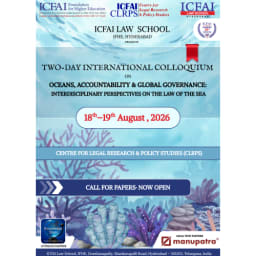 ICFAI Law School, ICFAI Foundation for Higher Education (IFHE), Hyderabad.
About the Colloquium
ICFAI Law School, IFHE Hyderabad, through its Centre for Legal Research & Policy Studies (CLRPS), is hosting a Two-Day International Colloquium on Oceans, Accountability & Global Governance: Interdisciplinary Perspectives on the Law of the Sea, on 18 and 19 August 2026 at the IFHE Auditorium, Donthanapally, Shankarapally Road, Hyderabad.
IFHE is a deemed-to-be university established under Section 3 of the UGC Act, 1956 and accredited by NAAC with an A++ grade. ICFAI Law School is recognised by the Bar Council of India and runs five-year integrated BBA LLB (Hons), BA LLB (Hons) and BA JLLB (Hons) programmes, a one-year LLM in Corporate and Commercial Laws and Tax Laws, full-time and part-time PhD programmes, PG diplomas and eight certificate courses.
CLRPS was set up in October 2024 to build interdisciplinary legal research and policy analysis at the law school. It works through integrated doctrinal and empirical methods, collaborative projects linking law with the social sciences, advanced research skills training including statistical software proficiency, and research meant to inform policy debate and law-making.
Concept Note and Rationale
The global ocean covers over seventy percent of the planet and serves as a vital ecological and economic commons, yet fragmented sovereignty and blurred maritime jurisdictions make it genuinely hard to govern. The 1982 United Nations Convention on the Law of the Sea remains the foundational constitution for the oceans, but its framework now faces unprecedented strain.
The organisers point to climate induced sea level rise redrawing maritime baselines, impending commercial deep-seabed mining, the 2023 Agreement on Biodiversity Beyond National Jurisdiction (BBNJ), and emerging international advisory opinions on climate obligations, all of which are testing the traditional boundaries of state responsibility.
Their argument is that the law of the sea sits at the nexus of geopolitics, marine science, the blue economy, maritime security and global climate justice, so the response has to be interdisciplinary. For a pivotal maritime nation like India, with extensive stakes in the Indian Ocean Region, these are immediate strategic and environmental questions rather than academic abstractions. Over two days the colloquium brings scholars, practitioners and students together to examine the legal foundations and frontiers of ocean governance, interrogate accountability mechanisms, and work on the institutional reforms a multipolar, climate-stressed century demands.
Objectives
- To revisit the foundations and evolution of the law of the sea and assess its capacity to meet contemporary challenges.
- To critically examine accountability and dispute-settlement mechanisms in ocean governance.
- To foster dialogue across law, science, policy, economics and security studies.
- To centre the concerns of small island states, coastal communities and future generations.
- To build a scholarly record through a Scopus-indexed publication while giving emerging researchers a professional platform to engage with senior experts in ocean governance.
Programme Structure
The two days combine expert lectures, an online panel discussion and facilitated group deliberation, framed by an inaugural and a valedictory ceremony. The structure is designed to move from foundations, to contestation, to collaborative problem-solving.
- Expert lecture, Law of the Sea: Foundations & Evolution. Historical evolution and the contemporary challenges confronting the UNCLOS framework.
- Expert lecture, Accountability Mechanisms in Ocean Governance. Environmental law, deep-sea mining and the blue economy.
- Expert lecture, Disputes Under UNCLOS. ITLOS, arbitration and dispute settlement, with case studies, jurisprudence and emerging trends.
- Online panel discussion, Contested Waters. Maritime security, sovereignty and international law in a multipolar world, moderated among national and international experts and conducted online. Sub-topics cover sovereignty disputes and UNCLOS, maritime security architecture, and great-power rivalry in ocean governance.
- Facilitated group discussions. Participants divide into groups for a facilitated table discussion on selected sub-themes, followed by a presentation of group findings. Group A on Climate Change & Coastal Rights, covering sea-level rise, shifting baselines, displacement and the rights of coastal populations. Group B on Small Island States & Ocean Justice, covering existential risk, equity, loss and damage, and the voice of vulnerable nations. Group C on Maritime Security & the Indian Ocean Region, covering regional architecture, cooperation and the strategic future of the region.
- Inaugural and valedictory ceremonies. The colloquium opens with a welcome address, addresses by the Chief Guest and Guests of Honour, and the inaugural address. It closes with a summary of proceedings, release of the colloquium souvenir, felicitation of resource persons and distribution of certificates to participants.
Sub-Themes and Thematic Tracks
The colloquium welcomes original, unpublished research from students, scholars and practitioners across disciplines. The tracks below frame the conversation, and interdisciplinary submissions that bridge two or more tracks are especially encouraged.
- I. Foundations & Evolution of the Law of the Sea. Historical development of UNCLOS; maritime zones and baselines; the regime of the Area and the common heritage principle; customary international law of the sea.
- II. Accountability & Environmental Governance. Marine environmental protection; state responsibility and liability; pollution from vessels and land-based sources; due diligence and the precautionary approach.
- III. Deep-Sea Mining & the Blue Economy. The International Seabed Authority and the Mining Code; benefit-sharing; sustainable use of marine resources; ocean economy, fisheries and energy.
- IV. Dispute Settlement Under UNCLOS. ITLOS jurisprudence; Annex VII arbitration; provisional measures and advisory opinions; the interaction of fora and questions of jurisdiction.
- V. Climate Change, Sea-Level Rise & Coastal Rights. Statehood and maritime entitlements amid rising seas; climate displacement; loss and damage; the marine environment and climate obligations.
- VI. Small Island States & Ocean Justice. Equity and vulnerability; intergenerational and distributive justice; the agency of small island developing states in international law-making.
- VII. Maritime Security & the Indian Ocean Region. Freedom of navigation; piracy and IUU fishing; regional cooperation; the geopolitics of a multipolar maritime order.
- VIII. Biodiversity Beyond National Jurisdiction (BBNJ). The high-seas treaty; marine protected areas; area-based management tools; marine genetic resources and equitable access.
The organising committee notes that the tracks are indicative and non-exhaustive, and welcomes proposals on allied and emerging themes within the broad ambit of ocean governance and the law of the sea.
Guidelines for Paper Submission
Submission runs as a three-stage process: an initial abstract for selection, an oral presentation and discussion of the working paper during the colloquium, and a finalised full paper submitted after the event.
- Stage 1, abstract submission. Abstracts must be between 300 and 500 words, contain 4 to 6 keywords, and be accompanied by a short author biography.
- Stage 2, colloquium presentation. Authors present and discuss their active working papers during the event sessions. Advance submission of the working paper manuscript is optional.
- Stage 3, full paper submission. The final paper is submitted after the colloquium by the designated deadline, fully incorporating the feedback and suggestions received at the presentation stage.
- Full paper length must be between 4,000 and 8,000 words.
- Main body text in Times New Roman, 12 pt, with 1.5 line spacing and 1 inch margins on all sides.
- Citations must strictly follow APA 7th edition style, with footnotes in Times New Roman, 10 pt, single spaced.
- A maximum of two authors is permitted per research paper.
- All submissions must be completely original, unpublished, and not currently under evaluation by any other publication or platform.
- The manuscript must maintain an overall text similarity index below 10 percent.
- A strict zero percent AI-generated content rule is enforced, and all text must be the authors' own work.
- The initial abstract must be completed and uploaded exclusively through the official Google Form.
Who Should Attend
- Faculty, researchers and doctoral scholars
- Students of law, international relations, policy and environmental studies
- Practitioners, diplomats and civil servants
- Maritime, environmental and security professionals
The brochure describes the colloquium as open to both Indian and international participants, with a separate fee slab quoted in US dollars for international delegates.
Registration Fee
- Student and research scholar, participation with paper presentation: Rs 1,000, or USD 30 for international participants.
- Student and research scholar, participation only: Rs 500, or USD 20 for international participants.
- Academician or professional, participation with paper presentation: Rs 1,500, or USD 40 for international participants.
- Academician or professional, participation only: Rs 1,000, or USD 30 for international participants.
Registration ordinarily includes the conference kit, certificate of participation and food, covering breakfast, lunch and refreshments. Registration closes on 16 August 2026, and payment is made through the IFHE conference portal linked below.
Publication, Mode and Venue
Selected high-quality papers will be published in a Scopus-indexed edited book following peer review, and presentation at the colloquium is a prerequisite for publication. The brochure does not name the volume or the publisher, so treat the indexing as the organiser's stated intention and confirm it with the secretariat before relying on it.
The colloquium runs in person at the IFHE Auditorium, IFHE Campus, Donthanapally, Shankarapally Road, Hyderabad 501203, Telangana. One session, the Contested Waters panel discussion, is conducted online with national and international experts, but delegates themselves attend on campus. No remote attendance option is stated for the colloquium as a whole.
The colloquium is held under the patronage of Prof. (Dr.) T. Koti Reddy, Vice Chancellor (in-charge), and Prof. (Dr.) S. Vijayalakshmi, Registrar, IFHE Hyderabad, with Prof. (Dr.) Pujari Ravisekhararaju, Director, and Prof. (Dr.) Y. Pratap Reddy, Dean, ICFAI Law School. Dr. Sayan Das is the Convenor, supported by co-convenors Ms. Adwita Singh, Dr. Kanishka Tyagi, Dr. Shruti Kandoi, Ms. Anwesha Panigrahi, Dr. Aswathy and Ms. Barkha Joshi.