
Two-Day Single-Credit Course on New Criminal Laws and International Conference on Transforming Criminal Justice in India at DNLU Jabalpur (9-11 October 2026)
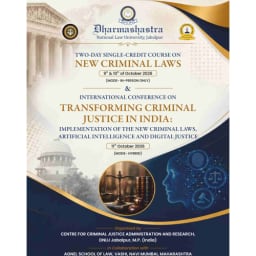 Dharmashastra National Law University, Jabalpur (in collaboration with Agnel School of Law, Vashi, Navi Mumbai).
About the Organisers
Dharmashastra National Law University, Jabalpur was established in 2018 by the Madhya Pradesh Dharmashastra National Law University Act, 24 of 2018, to advance value-based legal education at the undergraduate and postgraduate levels. The University places strong emphasis on research and scholarship and regularly organises seminars, conferences and workshops.
The programme is organised by the University's Centre for Criminal Justice Administration and Research (CJAR), which is dedicated to the continuous study of criminal law and its enforcement and brings together the Bar, the Bench, academics, policymakers and officials through conferences, seminars, podcasts, special lectures and publications. It is being held in collaboration with Agnel School of Law, Vashi, Navi Mumbai, established in 2018, affiliated to the University of Mumbai and approved by the Bar Council of India, which offers the 5-Year B.A. LL.B., 3-Year LL.B. and 2-Year LL.M. programmes.
About the Two-Day Single-Credit Course on New Criminal Laws
The intensive single-credit course runs on 9 and 10 October 2026 in in-person mode only at DNLU Jabalpur. It offers an in-depth exploration of the paradigm shift brought about by the Bharatiya Nyaya Sanhita, 2023, the Bharatiya Nagarik Suraksha Sanhita, 2023, and the Bharatiya Sakshya Adhiniyam, 2023, and is curated for legal professionals, academicians, research scholars, students and engaged citizens, bridging theoretical legal concepts and their practical application.
- Day 1 (9 October): inaugural address on constitutional constraints on sentencing discretion under the new criminal laws; Session I on the introduction to the BNS, deleted offences, inchoate offences and offences against women and children; Session II on offences affecting the human body, offences against the State, offences relating to coins, currency and stamps, offences against public tranquillity and terrorism; Session III on registration of a criminal case and investigation.
- Day 2 (10 October): Session IV on bail reforms and rights of the victim under the BNSS; Session V on trial timelines, trial in absentia, attachment of property and victim compensation; Session VI on electronic and forensic evidence; followed by an assessment and the valedictory ceremony with distribution of certificates.
About the International Conference and Its Theme
The International Conference on 11 October 2026 is on "Transforming Criminal Justice in India: Implementation of the New Criminal Laws, Artificial Intelligence and Digital Justice", and will be held in hybrid (physical and online) mode at DNLU Jabalpur.
The organisers note that alongside the legislative shift away from the colonial criminal law framework, the growing integration of artificial intelligence, digital technologies, electronic evidence, forensic science and cybersecurity has altered policing, investigation, prosecution, adjudication and correctional administration, raising legal, constitutional, ethical and practical questions for scholarly deliberation. The conference is intended as a platform for academicians, legal practitioners, researchers and students to deliberate on the implementation of the new criminal laws and the evolving role of technology in criminal justice administration.
Sub-Themes for Paper Submission
Submissions are invited on the following indicative, non-exhaustive sub-themes:
- Implementation of the Bharatiya Nyaya Sanhita, 2023: major substantive reforms, organised crime and terrorism, offences against women and children, community service and sentencing reforms, victim-centric justice, contemporary issues in criminal liability.
- Implementation of the Bharatiya Nagarik Suraksha Sanhita, 2023: criminal investigation reforms, police powers and accountability, arrest, bail, remand and trial procedures, electronic FIR and digital investigation, speedy trial and procedural efficiency, witness protection mechanisms.
- Bharatiya Sakshya Adhiniyam, 2023: digital and electronic evidence, scientific investigation, expert evidence and forensic science, admissibility of electronic records, evidentiary standards in the digital era.
- Artificial Intelligence and Criminal Justice: AI-assisted policing, predictive policing, AI in prosecution, AI-assisted judicial decision-making, intelligent legal research, court automation and e-Courts.
- Cybercrime and Digital Justice: emerging cyber offences, cryptocurrency crimes, cyber terrorism, online financial fraud, digital investigations, cross-border cybercrime.
- Digital Forensics and Scientific Investigation: DNA evidence, digital forensic laboratories, blockchain evidence, mobile and cloud forensics, AI-assisted forensic analysis.
- Privacy, Ethics and Constitutional Governance: privacy and surveillance, data protection, algorithmic accountability, bias in AI systems, constitutional safeguards, human rights in digital criminal justice.
- Victim-Centric Criminal Justice: victim compensation, restorative justice, victim participation, gender justice, child rights, witness support mechanisms.
- Comparative Criminal Justice Reforms: comparative perspectives on criminal law reforms, international best practices, technology-driven justice systems, UN standards, comparative evidence laws.
- Any other contemporary issue related to the conference theme.
Who Can Register
Both the course and the conference are open to academicians, advocates, legal professionals, research scholars and individuals, as well as students pursuing an undergraduate or postgraduate programme at any recognised university. Original and unpublished research papers for the conference are invited from academicians, professionals, practitioners, research scholars and students.
Submission Guidelines
Submissions may be doctrinal, empirical, comparative, interdisciplinary or policy-oriented, and authors are encouraged to offer innovative solutions and policy recommendations addressing contemporary criminal justice challenges.
- Abstract: 300 to 500 words, including the title of the paper, author names, institutional affiliation, email address, contact number, theme and sub-theme, and 4 to 6 keywords.
- Full paper: 4,000 to 8,000 words, original and unpublished work only.
- Formatting: Times New Roman; title 16 bold, headings 14 bold, text 12, footnotes 10; line spacing 1.5.
- Citation style: Bluebook (21st edition).
Registration Fee
For the two-day single-credit course on 9 and 10 October, the fee without accommodation is INR 3,000 for academicians and advocates, INR 2,000 for research scholars, INR 1,500 for students and INR 500 for DNLU students. With accommodation for two days, the fee is INR 5,000 for academicians and advocates, INR 4,000 for research scholars and INR 3,000 for students; accommodation is not applicable for DNLU students.
For the international conference on 11 October, offline participants pay INR 1,000 (advocates and academicians), INR 750 (research scholars), INR 750 (students) and INR 500 (DNLU students) without accommodation, and INR 2,000, INR 1,500 and INR 1,500 respectively with one day of accommodation. Online participants pay INR 750 (advocates and academicians), 50 USD (foreign nationals), INR 750 (research scholars), INR 500 (students) and INR 250 (DNLU students).
How to Apply
Registration for the two-day single-credit course opened on 19 August 2026 and closes on 30 September 2026 through the dedicated Google Form, with the fee payable on the DNLU ERP event page linked below. Registration for the international conference is through a separate Google Form; abstracts must reach the organisers by 15 September 2026, acceptance is notified on 18 September 2026, conference fee payment and registration close on 20 September 2026, and full papers are due by 2 October 2026. Queries may be addressed to CJAR at cjar@mpdnlu.ac.in.
What Participants Get
Participants of the two-day course earn a single credit and receive certificates at the valedictory ceremony. For the conference, certificates are issued to offline participants and e-certificates to registered online participants. Selected abstracts may be considered for publication in the conference souvenir with ISBN, and selected papers, subject to peer review, may be considered for publication in an edited book or ISBN volume, or in an edited journal publication.